
Qualitative data, the bedrock of understanding human experiences and complex phenomena, offers a profound departure from the numerical rigidity of its quantitative counterpart. This approach delves into the ‘why’ behind the ‘what,’ providing rich, nuanced insights that statistics alone cannot capture. From exploring customer satisfaction to understanding societal trends, qualitative research provides the tools to uncover hidden patterns and generate deeper meaning.
This exploration will navigate the intricacies of qualitative data, starting with its foundational principles and methodologies. We’ll examine the art of gathering insights through interviews and focus groups, and dissect the meticulous processes of data transcription and coding. The importance of ensuring rigor and trustworthiness, alongside ethical considerations, will also be discussed. Ultimately, this analysis will illuminate the versatile applications of qualitative data across diverse disciplines, revealing its power to inform decision-making and drive impactful change.
Delving into the Processes of Data Transcription and Coding for Qualitative Research helps to understand the process.
Qualitative research thrives on the richness of textual and visual data, often gleaned from interviews, focus groups, and observations. Transforming this raw data into meaningful insights requires meticulous processes of transcription and coding. These steps are crucial for ensuring the reliability and validity of findings, allowing researchers to identify patterns, themes, and ultimately, draw informed conclusions. The following discussion illuminates the intricate steps involved in these processes.
Data Transcription and Coding: Meticulous Steps
Transcription is the initial step, transforming audio or video recordings into written text. Accuracy is paramount, as errors here can propagate throughout the analysis. Coding, the subsequent step, involves systematically categorizing and labeling segments of the transcribed data to identify key themes and concepts. This iterative process allows researchers to move from raw data to a structured understanding of the research topic.
The process of transcription involves several key steps:
- Preparation: This includes gathering all necessary materials, such as the audio/video recordings, transcripts (if available), and any relevant background information about the participants and the research context. Ensure a quiet environment and reliable equipment.
- Listening and Initial Transcription: The transcriber carefully listens to the recording, pausing frequently to type what is heard. This initial transcription often results in a “first draft.”
- Review and Revision: The transcriber meticulously reviews the initial transcript, comparing it against the original recording. This involves correcting errors, clarifying ambiguities, and adding nonverbal cues (e.g., pauses, laughter, emphasis).
- Formatting and Editing: The final step involves formatting the transcript according to a specific style guide or project requirements. This might include using specific fonts, margins, and headings, as well as removing any identifying information to maintain participant anonymity.
Coding, following transcription, involves a series of steps:
- Familiarization: The researcher immerses themselves in the transcribed data, reading and re-reading the transcripts to gain a comprehensive understanding of the content.
- Developing Initial Codes: The researcher begins to identify key concepts, themes, and ideas within the data. These initial codes are often derived from the research questions, literature review, and the researcher’s own understanding of the topic.
- Applying Codes to Data: The researcher systematically applies the codes to the data, assigning labels to relevant segments of text. This can be done manually or with the assistance of qualitative data analysis software (QDAS).
- Refining Codes and Developing Themes: The researcher reviews the coded data, looking for patterns and relationships between the codes. This often leads to the development of broader themes that capture the essence of the data.
- Iterative Process: The coding process is often iterative, with researchers refining their codes and themes as they analyze more data.
Common Challenges in Data Transcription and Coding
Data transcription and coding are not without their challenges. The accuracy and validity of the research depend on the researcher’s ability to navigate these issues effectively.
- Transcription Challenges: Background noise, unclear speech, and accents can make transcription difficult. Solutions include using high-quality recording equipment, transcribing in a quiet environment, and slowing down the playback speed when necessary.
- Coding Challenges: The subjective nature of interpretation can lead to inconsistencies in coding. Inter-coder reliability, where multiple researchers code the same data and compare their results, can help mitigate this. Detailed codebooks, which define each code and provide examples, also improve consistency.
- Time Constraints: Both transcription and coding are time-consuming processes. Researchers should allocate sufficient time for these tasks and consider using software to assist with the process.
- Researcher Bias: Researchers’ pre-conceived notions can influence their interpretation of the data. Maintaining reflexivity, acknowledging one’s biases, and seeking feedback from others can help mitigate this.
Visual Representation of the Coding Process
The coding process can be visualized as a hierarchical structure, moving from raw data to abstract themes.
Imagine a table. The first column is labeled “Raw Data” and contains short excerpts from interview transcripts. These excerpts are chosen for their relevance to the research questions. The second column, “Initial Codes,” lists the specific codes applied to each excerpt. These codes represent the initial interpretations of the data. The third column, “Theme Development,” groups related codes together to form broader themes. These themes represent the overarching patterns and insights emerging from the data. Finally, a fourth column, “Theme Summary,” offers a brief description of each theme, along with supporting evidence from the raw data.
For example:
| Raw Data | Initial Codes | Theme Development | Theme Summary |
|---|---|---|---|
| “I felt completely overwhelmed by the amount of work.” | Workload, Stress | Work-Life Balance | Participants reported experiencing high levels of stress due to heavy workloads. |
| “The deadlines were impossible to meet.” | Time Pressure, Inefficiency | Work-Life Balance | Participants cited unrealistic deadlines as a major contributor to their stress. |
| “I had no time for my family.” | Family Conflict, Sacrifice | Work-Life Balance | Participants described the impact of work on their personal relationships. |
This visual representation illustrates the systematic transformation of raw data into meaningful themes, demonstrating how qualitative research generates insights. This table structure facilitates a clear understanding of the coding process, emphasizing the connection between the raw data and the final interpretations. The visual clarifies how the codes act as a bridge, linking specific data points to the broader thematic understanding.
Uncovering the Techniques for Ensuring Rigor and Trustworthiness in Qualitative Studies is crucial for quality.
Qualitative research, with its focus on understanding complex social phenomena, demands a commitment to rigor and trustworthiness. Unlike quantitative research, which often relies on numerical data and statistical analysis, qualitative studies employ methods that prioritize in-depth understanding and nuanced interpretation. Establishing the validity and reliability of qualitative findings requires careful attention to the research process, data analysis, and the presentation of results. This involves employing various strategies to ensure the findings are credible, transferable, dependable, and confirmable.
Strategies for Ensuring Validity and Reliability
Researchers employ several strategies to enhance the validity and reliability of qualitative research. These strategies are designed to address potential biases, enhance the accuracy of interpretations, and increase the confidence in the study’s findings. These approaches often overlap and are used in combination to strengthen the overall trustworthiness of the research.
One key technique is triangulation, which involves using multiple sources of data, methods, or investigators to corroborate findings. For instance, a researcher studying the experiences of nurses in a hospital might collect data through interviews, observations of nursing practice, and a review of hospital records. By comparing and contrasting the information obtained from these different sources, the researcher can identify converging themes and patterns, thereby increasing the credibility of the findings. Discrepancies between data sources are also valuable, prompting further investigation and refinement of interpretations.
Another important strategy is member checking. This involves sharing the researcher’s interpretations and findings with the participants in the study to ensure accuracy and obtain their feedback. For example, after transcribing and analyzing interview data, the researcher might provide the participants with a summary of the key themes and ask them to confirm whether these themes accurately reflect their experiences. Member checking not only enhances the validity of the findings but also empowers participants and ensures their perspectives are accurately represented.
Audit trails are also crucial for demonstrating rigor. An audit trail is a detailed record of the research process, including data collection, analysis, and interpretation. This trail allows other researchers to review the study’s methods and findings and assess their trustworthiness. The audit trail should include all raw data, transcripts, field notes, coding schemes, and memos. This documentation provides transparency and allows for an external review of the research process.
Finally, reflexivity is essential in qualitative research. Reflexivity involves researchers acknowledging and reflecting on their own biases, assumptions, and perspectives and how these might influence the research process. Researchers may keep a reflexive journal to record their thoughts and feelings throughout the study. This self-awareness helps researchers to identify potential biases and mitigate their impact on the findings.
Establishing Trustworthiness in Qualitative Studies: Examples and Actions
Researchers actively establish trustworthiness through specific actions. These actions are designed to address potential biases and ensure the findings are credible and reliable. These actions are essential to building confidence in the study’s results.
For example, to address potential researcher bias, a researcher might engage in peer debriefing. This involves presenting the study’s findings to other researchers or experts in the field for critical feedback and evaluation. Peer debriefing can help to identify blind spots in the analysis and challenge the researcher’s interpretations.
Another example is using thick descriptions. Thick descriptions involve providing rich, detailed accounts of the research context, participants, and data. This allows readers to understand the context of the study and assess the relevance of the findings to their own settings. The researcher might include detailed descriptions of the physical environment, the social dynamics of the setting, and the participants’ backgrounds and experiences.
To address potential participant bias, researchers might use multiple data sources, such as interviews, observations, and document analysis. This helps to corroborate the findings and ensure that the participants’ perspectives are accurately represented. The researcher might also use member checking to verify the accuracy of their interpretations with the participants.
Key Elements of Trustworthiness in Qualitative Research
The trustworthiness of qualitative research is evaluated based on several key elements. These elements are interconnected and work together to ensure the credibility, transferability, dependability, and confirmability of the findings. These elements are the cornerstone of a rigorous qualitative study.
- Credibility: This refers to the truthfulness and believability of the findings. Researchers enhance credibility through techniques like triangulation, member checking, and prolonged engagement in the field. For instance, a study on patient experiences might gain credibility by using data from patient interviews, medical records, and observations of patient-doctor interactions.
- Transferability: This addresses the extent to which the findings can be applied to other contexts or settings. Researchers enhance transferability by providing detailed descriptions of the study context and participants. This allows readers to assess the relevance of the findings to their own situations. A study describing the implementation of a new teaching method in a specific school setting, for example, would provide detailed information about the school’s demographics, resources, and culture to enable others to determine if the findings are applicable to their own educational environments.
- Dependability: This focuses on the consistency and stability of the findings. Researchers enhance dependability through techniques like audit trails, which provide a clear record of the research process. This allows other researchers to evaluate the study’s methods and findings and assess their trustworthiness. A researcher documenting all decisions made during data analysis, from initial coding to theme development, contributes to the dependability of the study.
- Confirmability: This addresses the objectivity of the findings and the extent to which they are supported by the data. Researchers enhance confirmability by using techniques like reflexivity and peer debriefing. This helps to ensure that the findings are not simply a reflection of the researcher’s biases or assumptions. For instance, a researcher documenting their own assumptions and biases throughout the research process, and then comparing the data analysis results with the peer review’s results.
Understanding the Role of Qualitative Data in Mixed-Methods Research enhances its application.
Mixed-methods research strategically combines qualitative and quantitative data collection and analysis to offer a more comprehensive understanding of a research problem. This approach leverages the strengths of both methodologies, mitigating their individual limitations. Qualitative data provides rich, contextual insights, while quantitative data offers numerical precision and generalizability. Their integration allows researchers to explore complex phenomena with greater depth and breadth, leading to more robust and nuanced findings.
Integrating Qualitative and Quantitative Data
The integration of qualitative and quantitative data within mixed-methods designs creates a synergistic effect, enhancing the research’s power. Qualitative data can illuminate the ‘why’ behind quantitative findings, providing context and meaning to numerical results. For example, if a quantitative study reveals a correlation between stress levels and job satisfaction, qualitative interviews can explore the specific stressors and coping mechanisms employees employ, offering a deeper understanding of the relationship. Conversely, quantitative data can validate or expand upon qualitative findings, allowing researchers to assess the prevalence or generalizability of themes identified through qualitative analysis. This iterative process allows researchers to triangulate findings, strengthening the validity and reliability of the overall study.
Examples of successful mixed-methods research include studies investigating the impact of educational interventions. Quantitative data, such as test scores, can measure the effectiveness of the intervention, while qualitative data, such as classroom observations and student interviews, can provide insights into the students’ experiences, challenges, and perspectives on the intervention. Another example involves public health research where quantitative surveys assess the prevalence of a disease, and qualitative focus groups explore the community’s perceptions, beliefs, and behaviors related to the disease, informing targeted interventions.
Hypothetical Research Question: How does access to healthcare services impact patient satisfaction and health outcomes in rural communities?
* Quantitative Approach: Conduct a survey among patients in rural communities to measure patient satisfaction (using a standardized scale) and collect data on health outcomes (e.g., hospital readmission rates, chronic disease management). Analyze the quantitative data to identify correlations between access to services (e.g., distance to clinics, availability of specialists) and the measured outcomes.
* Qualitative Approach: Conduct in-depth interviews with patients, healthcare providers, and community leaders to explore their experiences and perceptions regarding access to healthcare. Analyze the qualitative data to identify themes related to barriers to access, patient experiences, and the impact of healthcare access on their well-being.
Exploring the Ethical Considerations in the Realm of Qualitative Data Collection is essential for responsible research.
Qualitative research, by its very nature, delves deeply into the lived experiences and perspectives of individuals. This intimate engagement demands a profound commitment to ethical principles, ensuring the well-being and rights of participants are paramount. Researchers must navigate a complex landscape, balancing the pursuit of knowledge with the responsibility to protect those who contribute their time and insights. Failure to do so can erode trust, compromise the integrity of the research, and cause significant harm to participants.
Ensuring Informed Consent, Confidentiality, and Participant Privacy
Ethical conduct in qualitative research begins long before data collection. It starts with establishing clear and transparent processes.
Informed consent is the cornerstone. Researchers must provide participants with comprehensive information about the study’s purpose, procedures, potential risks and benefits, and their right to withdraw at any time. This information should be presented in a language that participants understand, avoiding jargon. Consent should be freely given, without coercion or undue influence. For example, if a researcher is studying the experiences of healthcare workers, they must clearly explain the study’s goals, the types of questions they will ask, and how the data will be used, giving participants the right to decline or stop participation without penalty.
Confidentiality and privacy are inextricably linked. Researchers must safeguard participant data, protecting their identities and personal information. This involves using pseudonyms, storing data securely, and limiting access to sensitive information. Data anonymization techniques, such as removing identifying details, are crucial. Consider a study on domestic violence. The researcher needs to ensure that the participants’ real names are not revealed in the final report, using pseudonyms instead. Any audio or video recordings must be stored in a secure location, accessible only to the research team. Furthermore, participants must be informed about how their data will be stored, used, and eventually disposed of.
Understanding the Importance of Reflexivity in Qualitative Research
Reflexivity, or self-awareness, is a critical component of ethical qualitative research. Researchers must acknowledge their own biases, assumptions, and perspectives and how these might influence the research process and the interpretation of findings.
This involves critically examining one’s own positionality, including factors like race, gender, class, and personal experiences. This self-reflection is an ongoing process, not a one-time event. Researchers should keep a reflective journal throughout the study, documenting their thoughts, feelings, and reactions to the data and the participants. For example, a researcher studying the experiences of immigrants might find their own experiences as an immigrant or as a child of immigrants influences how they interpret the stories they are hearing. Acknowledging this and documenting how it affects the analysis is critical.
The goal is not to eliminate bias, which is impossible, but to recognize it and mitigate its potential impact. By being reflexive, researchers enhance the trustworthiness and credibility of their work, making their findings more robust and reliable.
Navigating Potential Ethical Dilemmas in Qualitative Research
Qualitative researchers often face complex ethical dilemmas. Here are some common challenges and strategies for addressing them:
- Power Imbalances: Researchers often hold more power than participants.
- Researcher-Participant Relationships: Maintaining appropriate boundaries can be difficult.
- Data Security and Storage: Protecting sensitive information is crucial.
- Informed Consent Challenges: Obtaining informed consent can be difficult in certain populations or settings.
- Unexpected Findings: Discovering information that could potentially harm participants.
Solution: Establish clear boundaries, be transparent about your role, and empower participants to voice concerns.
Solution: Avoid dual relationships (e.g., being a therapist and a researcher). Be professional and respectful.
Solution: Use secure storage methods, anonymize data, and adhere to data protection regulations.
Solution: Adapt consent procedures to the specific context. Ensure participants understand the information.
Solution: Have a plan for dealing with sensitive information, and consider reporting obligations.
Evaluating the Advantages and Limitations of Qualitative Data illuminates its scope.
Qualitative data, with its emphasis on in-depth understanding and nuanced perspectives, plays a crucial role in research across various disciplines. Its ability to explore complex phenomena, capture rich contextual information, and generate insightful interpretations makes it a valuable tool. However, like any methodology, qualitative research also has limitations that must be acknowledged and addressed to ensure the validity and reliability of findings. This section delves into the advantages and disadvantages of qualitative data, providing a comprehensive understanding of its strengths and weaknesses.
Advantages of Qualitative Data
The benefits of using qualitative data are numerous, primarily centered around its ability to provide a comprehensive and nuanced understanding of complex issues.
- Rich, In-Depth Understanding: Qualitative research excels at providing rich, detailed descriptions of experiences, perspectives, and behaviors. Through methods like interviews and focus groups, researchers can gather in-depth information that goes beyond surface-level observations. For example, a study examining patient experiences with a new medication could use qualitative interviews to uncover not only the physical effects but also the emotional and social impact of the treatment. This level of detail is often missed by quantitative methods.
- Exploration of Complex Phenomena: Qualitative data is particularly well-suited for exploring complex phenomena that are difficult to quantify. Topics such as cultural values, social interactions, and personal beliefs can be explored effectively through qualitative research. Consider a study on the impact of social media on adolescent mental health. Qualitative methods, such as analyzing online conversations and conducting in-depth interviews, can help researchers understand the intricate ways in which social media influences self-esteem, social connections, and mental well-being.
- Flexibility and Adaptability: Qualitative research is inherently flexible and adaptable. Researchers can adjust their methods and questions as they gain a deeper understanding of the topic. This allows for an iterative approach where insights from early data collection inform subsequent stages of the research. For example, a researcher conducting ethnographic fieldwork in a new community can modify their interview guide based on initial observations and interactions, ensuring the research remains relevant and responsive to the community’s needs.
- Generation of New Hypotheses: Qualitative research is excellent for generating new hypotheses and theories. The exploratory nature of qualitative methods allows researchers to identify patterns, themes, and unexpected findings that can lead to the development of new research questions. For instance, a qualitative study on consumer behavior might uncover previously unknown motivations for purchasing a particular product, leading to the formulation of new hypotheses about consumer decision-making processes.
Comparing Qualitative and Quantitative Data
Understanding the strengths and weaknesses of qualitative data requires a comparison with its quantitative counterpart. These two approaches offer distinct advantages and disadvantages, and often complement each other in mixed-methods research designs.
- Breadth vs. Depth: Quantitative data generally excels at providing breadth – the ability to collect data from a large number of participants, allowing for statistical analysis and generalization of findings. Qualitative data, on the other hand, prioritizes depth, offering a more nuanced understanding of a smaller number of cases. For example, a survey (quantitative) might measure the prevalence of a certain behavior in a population, while in-depth interviews (qualitative) could explore the reasons behind that behavior.
- Objectivity vs. Subjectivity: Quantitative research often strives for objectivity, using standardized measures and statistical techniques to minimize researcher bias. Qualitative research, while aiming for rigor, acknowledges the subjective nature of human experience. Qualitative researchers often interpret data based on their understanding of the context, recognizing that multiple interpretations are possible. For example, a quantitative study might measure the effectiveness of a new teaching method through standardized tests, while a qualitative study might explore students’ perceptions of the method through focus groups and interviews.
- Generalizability vs. Transferability: Quantitative findings are often designed to be generalizable, meaning the results can be applied to a larger population. This is achieved through the use of random sampling and statistical inference. Qualitative findings are often not generalizable in the same way. Instead, qualitative research aims for transferability – the ability to apply findings to similar contexts or situations. For example, a quantitative study on the impact of a new policy might aim to generalize the results to the entire population, while a qualitative study might explore the impact of the policy on specific groups, allowing for the transfer of insights to other similar groups.
Illustration of Advantages and Disadvantages
The following illustration visually represents the advantages and disadvantages of qualitative data:
A large circle is divided into two unequal segments. The larger segment, representing the advantages, is labeled “Qualitative Data Strengths” and is further divided into three sections. The first section, taking up the most space, depicts a magnifying glass focusing on a detailed image of a person’s face, symbolizing “Rich, In-Depth Understanding.” The second section shows a complex network of interconnected lines and nodes, representing “Exploration of Complex Phenomena.” The third section illustrates a flexible, winding path, representing “Flexibility and Adaptability.” The smaller segment, labeled “Qualitative Data Weaknesses,” contains three smaller sections. The first section shows a small sample size compared to the larger population, symbolizing “Limited Generalizability.” The second section displays a researcher interpreting data with a question mark above their head, symbolizing “Potential for Researcher Bias.” The third section depicts a time-consuming hourglass, representing “Time-Intensive Data Collection and Analysis.” A line connects the two main segments, highlighting the trade-offs inherent in qualitative research. This visual representation underscores the scope of qualitative research, highlighting its capacity for deep understanding while acknowledging its limitations in terms of generalizability and potential for bias.
Illustrating the Application of Qualitative Data Across Various Disciplines demonstrates its versatility.
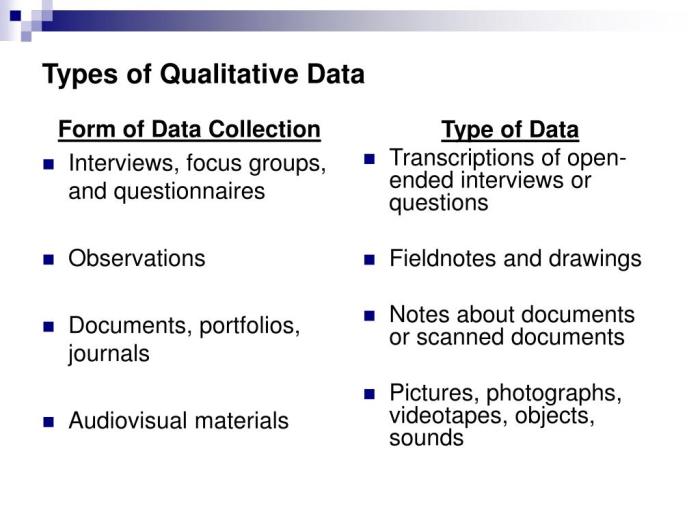
Qualitative data, rich in context and nuance, provides invaluable insights across a multitude of disciplines. Its ability to explore the “why” behind phenomena, rather than just the “what,” makes it a powerful tool for understanding human behavior, experiences, and perspectives. This adaptability allows researchers to gain a deeper comprehension of complex issues and inform evidence-based decision-making. The following sections will detail the applications of qualitative data across healthcare, education, marketing, and sociology, showcasing its impact and versatility.
Healthcare Applications of Qualitative Data
Qualitative research is vital in healthcare for understanding patient experiences, improving healthcare delivery, and developing effective interventions. This approach moves beyond numerical data to explore the lived realities of patients and healthcare providers.
- Understanding Patient Experiences: Qualitative methods, such as in-depth interviews and focus groups, are used to explore patients’ experiences with illness, treatment, and healthcare services. This helps identify areas for improvement in patient care. For example, research on the experiences of patients undergoing chemotherapy can reveal emotional challenges, side effects, and support needs, informing the development of more patient-centered care plans.
- Improving Healthcare Delivery: Qualitative data helps to evaluate the effectiveness of healthcare programs and identify barriers to access. Studies can examine healthcare professionals’ perspectives on implementing new policies or technologies, leading to more efficient and patient-friendly healthcare systems. For example, understanding the perspectives of nurses on the implementation of electronic health records can help streamline workflows and improve the quality of patient data.
- Developing Effective Interventions: Qualitative research guides the development of interventions tailored to specific patient populations. By understanding the cultural beliefs, attitudes, and behaviors related to health, researchers can create interventions that are more likely to be accepted and effective. This is particularly crucial in addressing health disparities and promoting health equity. For instance, qualitative research might explore cultural beliefs about diabetes management within a specific community to inform the design of culturally sensitive educational programs.
Educational Applications of Qualitative Data
In education, qualitative data helps to understand the complexities of teaching and learning environments. This data provides insights into student experiences, teacher practices, and the impact of educational policies.
- Understanding Student Experiences: Researchers use qualitative methods to explore students’ perspectives on their learning, classroom environment, and relationships with teachers and peers. This helps educators to identify factors that contribute to student success and well-being. For example, interviewing students about their experiences in online learning environments can help identify challenges and inform the development of more effective online teaching strategies.
- Improving Teaching Practices: Qualitative data helps to analyze teacher practices, classroom dynamics, and the impact of instructional strategies. Observations, interviews, and document analysis provide rich insights into how teachers implement new pedagogical approaches and how students respond to them. Research on teacher-student interactions can reveal patterns of effective communication and classroom management.
- Evaluating Educational Policies: Qualitative research is used to assess the impact of educational policies and reforms. By gathering perspectives from teachers, students, and administrators, researchers can evaluate the effectiveness of these policies and identify areas for improvement. For instance, studying the implementation of a new curriculum can reveal challenges, successes, and the need for adjustments.
Marketing Applications of Qualitative Data
Qualitative research is crucial in marketing for understanding consumer behavior, preferences, and motivations. This understanding helps businesses to develop effective marketing strategies and create products that meet consumer needs.
- Understanding Consumer Behavior: Qualitative methods, such as focus groups and in-depth interviews, are used to explore consumer motivations, attitudes, and perceptions of products and brands. This provides insights into why consumers make certain purchasing decisions. For example, conducting focus groups with potential customers can reveal their preferences for product features, packaging, and advertising messages.
- Developing Effective Marketing Strategies: Qualitative data helps to inform the development of marketing campaigns, product positioning, and brand messaging. By understanding consumer needs and desires, marketers can create campaigns that resonate with their target audience. Research on consumer responses to advertising campaigns can help refine messaging and improve campaign effectiveness.
- Creating Products that Meet Consumer Needs: Qualitative research helps businesses to identify unmet consumer needs and develop products that address those needs. This can involve exploring consumer preferences for product features, functionality, and design. For example, interviewing potential customers about their needs for a new mobile phone can inform the development of a product that meets those needs.
Sociology Applications of Qualitative Data
Qualitative data is fundamental in sociology for understanding social phenomena, social structures, and human interactions. It provides rich insights into the complexities of social life.
- Understanding Social Phenomena: Qualitative research is used to explore a wide range of social phenomena, such as social inequality, deviance, and social change. Methods like ethnography and participant observation allow researchers to immerse themselves in social settings and gain a deep understanding of social dynamics. For example, studying the experiences of marginalized communities can reveal the impact of social inequality.
- Analyzing Social Structures: Qualitative data helps to analyze social structures, such as institutions, organizations, and social networks. Researchers use interviews and document analysis to understand how these structures shape human behavior and social interactions. Research on organizational culture can reveal how social structures influence employee behavior and organizational performance.
- Understanding Human Interactions: Qualitative research provides insights into human interactions, communication patterns, and social relationships. Methods like discourse analysis and conversation analysis are used to study how people communicate and negotiate meaning in social settings. Studying the dynamics of family relationships can reveal how social interactions shape family dynamics and well-being.
Table: Uses of Qualitative Data Across Disciplines
| Discipline | Specific Research Question | Data Collection Methods | Impact on Decision-Making |
|---|---|---|---|
| Healthcare | What are the experiences of patients with chronic pain? | In-depth interviews, focus groups | Informs the development of patient-centered pain management programs. |
| Education | How do students perceive the effectiveness of online learning? | Student surveys, classroom observations | Improves online teaching strategies and curriculum design. |
| Marketing | What are the unmet needs of consumers in the market for sustainable products? | Focus groups, consumer interviews | Guides product development and marketing campaigns for sustainable products. |
| Sociology | How do social media platforms shape political discourse? | Content analysis of social media posts, interviews | Informs understanding of online social interactions and their impact on society. |
Closing Summary
In conclusion, qualitative data stands as an indispensable tool for researchers and analysts alike, offering a window into the complexities of human behavior and experience. By embracing its inherent subjectivity and employing rigorous methodologies, we can unlock a wealth of knowledge, generate meaningful insights, and ultimately, make more informed decisions. Its ability to provide rich, contextual understanding makes it a critical component of any comprehensive research endeavor, shaping our understanding of the world around us.
